
Part I
For most of my high school years I identified rather quietly as a feminist because I did not feel welcome expressing my viewpoints in a community where feminism was the big “f” word, a sentiment I’ve now heard echoed by other women who grew up in similar environments. I never entirely understand the hate as it’s always seemed fairly straightforward to me that feminism was and is about women’s rights and equality.
It’s interesting to talk to female and male friends of mine who also hesitate to apply the feminist label to themselves, sometimes because they believe feminism is about hating men or because they believe we don’t need feminism anymore (something I’ve heard a lot more frequently in the past weeks). I suppose at the end of the day “feminist” is just a label and actions are always more important than a label, but I’ve often found that hesitance to call oneself a feminist is based more on misinformation about what feminism is and who feminists are than it is about being against women’s rights.
Feminism is a broad and evolving movement, which is why there will always be a lot of debate about what it is and what it means, but I believe most people would agree with these three general core components: working for equal opportunity and women’s rights, supporting and respecting other women’s choices, and working against harmful sexist and gendered attitudes that affect both men and women. At the end of the day, feminism is the “radical notion that women are people too.”
Taking a women’s studies class in college introduced me to a more thorough understanding of the wide range of feminist issues, and I feel really lucky to have had the opportunity to take that class. It will be interesting to see what fourth-wave feminism brings and how it might grow to encompass the experiences and needs of all kinds of women (a lot of criticism of feminism has rightly centered on it being a movement only for white women).
As for myself, I’m a feminist both out of gratefulness to the long history of women paving the way before me and for the needs in the present. I’m a feminist because it was less than 100 years ago that women gained the right to vote. I’m a feminist because I’m thankful to have more than two career options, and I’m glad that my choice on where to attend college isn’t dictated by my sex. I’m a feminist because I believe women should have the right to wear what makes them comfortable—whether that’s pants or a dress or a bikini or a one piece. And I’m a feminist today because not every woman yet has the right to attend school or college, travel, speak her mind freely, wear what she freely chooses, or to make decisions about her body and health, and some people still think it’s ok to talk about women like they’re non-humans. There are so many reasons, and these are only a few. I believe it’s important to identify as a feminist because I reject the notion that feminism is about man-hating or putting others down; it’s harmful to let outliers dictate what this word and movement is. I believe we need feminism more than ever, and for this reason, I’ve decided to be a bit more open about unashamedly identifying as a feminist.
Part II
How does it feel to be a woman on November 9.
Our bodies teach us. A conversation with a friend touched on this. We talked about a very real emotional and physiological response present in our bodies, feeling as if a weight pressed down on our bodies; a grief for what we had hoped for, a sadness for ourselves and all our fellow women, a sinking wonder of not feeling at home in our bodies that day, a haunting question– if we were sexually assaulted or raped too, would there always be some issue more important than standing up for us, some reason to not draw a clear line about what is okay and what is not?
November 9 felt like a victory for every time I or any woman been cat called, every time I or any woman ever felt unsafe walking alone, every time I or any woman had been told to brush a sexist joke aside because we’re just too “sensitive,” every time I or any woman had had our ideas dismissed then immediately believed when a man said them. I know my burden isn’t nearly as heavy as it is for the many women who’ve been sexually assaulted or raped and felt especially angered or anxious on November 9 or as heavy as it is for the many women who are now being harassed for being a woman who wears a head covering or isn’t white. These assaults and hate crimes are happening at a steady rate since November 9. I know I don’t have as much to worry about, and I’m lucky, but I still feel this weight, this dread, in my body from November 9. How are we supposed to be a beacon of freedom and equality around the world, when the new face of our country has bragged about sexually assaulting women and has been accused of rape by over a dozen women?
I do not have an answer.
Part III
Do we over exaggerate? Are we just “angry” women?
I saw this article a couple of weeks ago; it popped up in my news feed for some reason. I paused, stunned to not only read “can anybody recommend some good acid wash for my eyes?” but equally horrified by the less-than-tame comments, mainly centered on discussing the woman’s body.
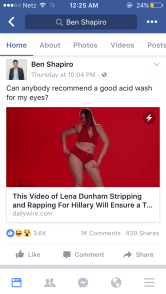
I don’t want to talk about who these people are (I’m well aware) because this isn’t as important as commenting on a wider, disconcerting problem regarding women and their bodies and how they are viewed not just by men but even other women.
A woman had displayed her body with confidence and power in a video and this was her fault: that she had no shame flaunting her body for artistic purposes even though she doesn’t have abs and probably has cellulite. That she used her body as she chose fit and accepted it as it was. This was reason for men to say they’d rather have acid in their eyes or they’d rather vomit than see a woman dance and reveal her non-society-beauty-approved body. In other words, her body was so disgusting to these men that they were willing to “joke” about subjecting themselves to incredibly painful acid or vomiting. They were repulsed by her body, the way we are repulsed by bad food or the smells of sewage or blood.
Disgust/repulsion is a response usually functioning as a self-protecting mechanism –an act to distance ourselves from that which might be harmful, like blood, which might carry a disease and be dangerous. Yet, viewing other people with disgust is a way to dehumanize them as it allows us to slowly believe that their presence might somehow be harmful to ourselves and because of that, they must be pushed away or even expelled. (I’m drawing a lot on Richard Beck’s “Unclean: Meditations on Purity, Hospitality, and Mortality,” which is a fascinating read discussing Christianity, disgust, and a religious need for “cleanliness.”)
For these men, it was okay to make fun of the actions and body of this woman because they felt disgusted by it–she was not human enough to them. Their disgust at her body (perhaps her beliefs too) allowed them to dehumanize her. For whatever reason, her use of her body—because it was contrary to how they believed she should use her body—gave them license to write incredibly sexist or hateful comments or in general, ridicule the woman in the video. Am I over exaggerating? Is this just a one-time instance? Are these just crazy people on a corner of the web? Perhaps.
Then again, it showed up in my newsfeed because a male acquaintance of mine—someone who claims to be a Christian—had commented something mean on the article too.
Part IV
It’s not an isolated event. It’s just been normal for far too long.
As someone who’s suffered from an eating disorder and body dysmorphia and worked for years to accept and connect with my body, whatever its size or appearance, and is a firm believer in body positivity for women and men, seeing this really enraged me—and that others brush it aside as it being somehow okay to talk about women like this because it’s “funny” or a “joke” or just “a bit exaggerated,” just like Trump’s words were just “locker room banter” and “boys will be boys.”
No.
Women’s bodies have long been viewed under the male gaze as gross (menstrual cycles), as shameful (wear this, don’t wear that, cover yourself!), as trophies, as something to be protected, as something to be ridiculed, as symbols of innocence and purity, or as the embodiment of the devil’s temptations. Men have long thought it’s okay that they get to decide how women’s bodies are viewed or talked about.
This is nothing new.
It is new that women have risen together and said: ENOUGH. I determine that I am beautiful. I am the only person who needs to accept my body. What I wear or don’t wear is not license to be ridiculed or assaulted. And it is not okay for me or any woman to be talked about or treated like this.
Maybe this is scary to some men (and even women who feel a need to judge other women). Some people take this collective call and rising up and dismiss it because women seem “angry,” as if any passion or emotion against injustice—righteous indignation—is grounds for dismissing legitimate calls for justice.
I’m a firm believer that our bodies speak wisdom to us, and that the emotional energy we carry in our bodies is intuitive and useful. To ignore our connection with our bodies is to be divided from ourselves. One theory I loved in feminist studies is the notion that women’s intuition is something that’s been dismissed by men and women alike because male-dominated science and academics decided it wasn’t useful or real. And that in our struggle for equality and a place at the table, women have had to suppress our femininity—we’ve had to “man up” and not seem sensitive or intuitive less the other men dismiss us. But the gender qualities typically associated with the female are something that other feminist scholars have argued have just as much value and usefulness in the workplace or elsewhere (for both men and women) as do the gender qualities associated with male.
I love what this woman said: “I want to empower women through dance. I think you can build confidence through movement. When a woman starts moving her body, and becomes comfortable with herself, and realizes that she can do the steps—it connects back to life. Because all of life is movement. Technically we’re dancing every day. And it doesn’t matter how you look. It matters how you move.”
When we women reconnect with our bodies, we find our power and strength. To connect with our bodies, that is a feminist act.
Part V
It’s not just going to be “ok.”
Of all the insulting and dismissive and privileged things you can say to someone.
The hate crimes still haven’t stopped and neither has sexism. November 9 was a very clear reminder that for far too many people neither sexual assault, nor hate, nor ridicule of minorities or the disabled was a line at all. We’ve guessed this for a while, but the event drove it home. It’s not just going to be okay without some very real acknowledgement of these issues and some very tough and personal work in our communities.
We still need feminism. Because of all the disgusting rhetoric that became front and center in the election, chief among them was the way Trump talked about women and their bodies. That he tweeted angrily at woman after woman. That women are attacked when they are smart. That Trump has now appointed man after man, who have been decidedly anti-woman in previous policy or associated with distinctly anti-women content.
On November 9, I and so many women listened to our bodies. We felt fear, we felt anxiety, we felt anger, but we also felt a loud: No. And with that “no,” we will stand up together to keep working for our rights and the rights of others, as this is what it means for me and so many other women to be a feminist.
 Sarah the Adventurer