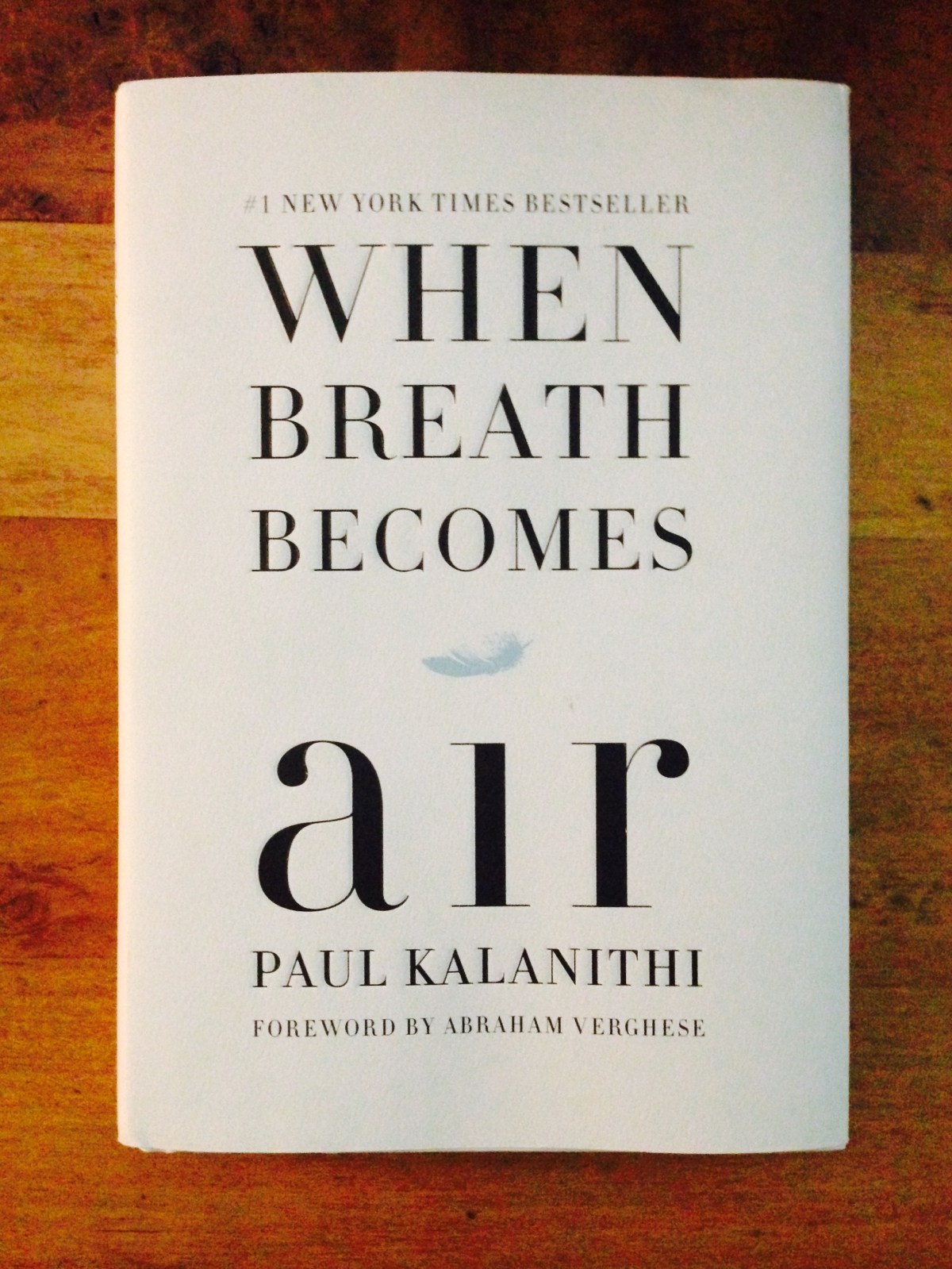
“I woke up in pain, facing another day–no project beyond breakfast seemed tenable. I can’t go on, I thought and immediately, its antiphon responded, completing Samuel Beckett’s seven words I had learned long ago as an undergraduate: I’ll go on. I got out of bed and took a step forward, repeating the phrase over and over: ‘I can’t go on. I’ll go on.’” — When Breath Becomes Air
When Breath Becomes Air is a beautiful, deeply-moving memoir written by Paul Kalanithi during his final months of fighting terminal lung cancer. I’ve wanted to read this book ever since one of my favorite blogs, A Cup of Jo, shared Paul’s captivating New York Times op-ed and later opened up about her family’s loss. (Paul was her brother-in-law.) Since I’ve enjoyed reading A Cup of Jo for several years (reading A Cup of Jo has always felt to me like that cool aunt who’s hip and curls up with you on the sofa to talk about anything over a cup of coffee), learning about his passing two years ago felt more personal–like finding out a dear friend had lost a family member. Even though I didn’t know him, there was something mesmerizing about his writing and his openness about grappling with his own mortality. If you’re looking for a good memoir to read and don’t mind one that might make you shed a few tears (or a few buckets…), I’d recommend this book. It’s impossible not to feel moved and inspired by Paul’s life.
I’d heard so many good things about the book but other than the presumption that the memoir would focus mainly on his cancer diagnosis, I wasn’t sure what to expect when I finally turned the first page to begin reading. The memoir does not just discuss the cancer diagnosis–it’s there–but pleasantly (and not surprisingly), it really gives you an intimate look into Paul’s life: he reflects on his childhood, chronicles his years in med-school, and discusses his decision and calling to become a neurosurgeon. What arises most clearly throughout the book is Paul’s ceaseless love for learning, his fascination and love of literature, his voracious inquisitiveness and philosophical mind. I only wish the book were longer–that Paul would have had more time to delve into these topics more fully, to share more of his thought-provoking observations and relate the events that shaped his understanding of medical ethics and life’s purpose.
I read this book in one sitting, and even though I knew what would happen in the end, I still found myself racing to the next page, wondering what would happen next. There was such a clear sense of Paul’s thirst and adventure for life still pulsing in the words he had written on the page; at moments it felt surreal to hold the book in my hands and follow Paul on his journey, knowing he was no longer alive, but feeling as if he lived on through his words.
As his book nears the end and as Paul’s condition worsens, his wife gives birth to their daughter, a poignant juxtaposition between beginning and end, between death and new life. Instead of looming sadness, Paul relates how much joy his daughter brings him with these words written to her at the end of the book:
“There is perhaps only one thing to say to this infant, who is all future, overlapping briefly with me, whose life, barring the improbably, is all but past.
That message is simple:
When you come to one of the many moments in life where you must give an account of yourself, provide a ledger of what you have been, and done, and meant to the world, do not, I pray, discount that you filled a dying man’s days with a sated joy, a joy unknown to me in all my prior years, a joy that does not hunger for more and more but rests, satisfied. In this time, right now, that is an enormous thing.”
— When Breath Becomes Air
If you’re like me, you will cry (sob) at the end, especially when reading the beautiful essay written by his wife. I couldn’t help but be reminded by Paul of someone who was very special to me and can’t imagine how agonizing his wife’s loss must have felt. Still, in the face of grief and loss, the words from Paul’s memoir come back to mind: “I can’t go on. I’ll go on.” In this mess of life, sometimes taking the next step in quiet confidence is all there is to do, and Paul’s memoir and life is a beautiful chronicle of that.
 Sarah the Adventurer