 Perhaps you’ve noticed that I’ve been blogging more, sharing more poetry, and even dancing on Instagram. This creative output hasn’t been accidental. But it’s not because of better time management skills or willpower or random bursts of creative inspiration. My emerging creative practice has bubbled up from going through The Artist’s Way.
It was my cousin who first heard of Julia Cameron’s book The Artist’s Way and mentioned it to me all the way back during my freshman or sophomore year of college. I bought the book, eager to become more “creative,” but my enthusiasm faded, other commitments took precedent, and I never made it past the first couple chapters. Last year I even packed it with me to Germany, certain that I’d get through it with all the free time I had, but I didn’t even make it past chapter three. Perhaps I wasn’t disciplined enough; perhaps it’s the kind of journey you can’t force.
Since I’ve had this book since 2013, when I put it on my list of “24 things to do while 24” last June, I did so with a low expectation for myself – make it past chapter 3. That was in June and I didn’t even open the book until November. But on November 5, I “officially” started it, and on April 22 (26 weeks later!), I finished the whole book. Today I’m marking this event and celebrating the completion of one journey and the beginning of another (and yes, I’m planning to bake a cake to celebrate!).
What is this book?
You’re probably wondering what this book is and what it’s about and why it’s been so difficult to get through. I should probably refer to it as “course,” especially since Cameron calls it that herself. The subtitle of The Artist’s Way reads: “A course in discovering and recovering your creative self…a spiritual path to higher creativity.” It’s organized into twelve chapters and each chapter, which is supposed to take one week to complete, comes with tasks and assignments. So it’s more of a workbook than the kind of book you read from start to finish, and it requires willingness to examine the things you do and the things you believe that keep you creatively blocked. This demands a lot of reflection and honesty. In other words, going through this book is not always the easiest thing in the world. Indeed, rather than approaching this as a series of writing prompts or assignments, it’s best to approach it a spiritual/creative journey.
This spiritual component of the journey is Cameron’s core underlining philosophy – the creative and spiritual are intertwined, maybe one in the same: “Creativity is an experience – to my eye, a spiritual experience. It does not matter which way you think of it: creativity leading to spirituality or spirituality leading to creativity” (2). For me, this was a fairly new framework to think about creativity – as a spiritual practice, as much as yoga is. And that rather than waiting for creativity to strike randomly, to learn to cultivate ritual and invite mystery in as part of the creative practice. While it was new for me, this is really nothing new: “Artists throughout the centuries have spoken of ‘inspiration,’ confiding that God spoke to them or angels did. In our age, such notions of art as a spiritual experience are seldom mentioned. And yet, the central experience of creativity is mystical.” (xix, emphasis added). Later on, Cameron adds, “Mystery is at the heart of creativity” (195).
If you’re skeptical of or don’t resonate with the word “God,” which appears throughout the book, Cameron suggests calling it “spiritual electricity,” “creative force,” or even “Good Orderly Direction.” Whatever floats your boat. I also love this quote by Mary Daly: “Why indeed must ‘God’ be a noun? Why not a verb…the most active and dynamic of all?’” Personally, Cameron’s belief in creativity as a spiritual experience — something we can simply tune into and channel rather than have to “think up” — really resonated with me.
How has this book affected me?
It’s taken me a lot of restraint to not talk about / write about The Artist’s Way while I’ve been doing it—it was so exciting and wonderful that I wanted to share it immediately. But this quietness and privacy has been an important part of letting change and new ways of thinking take root. Occasionally, I talked about it with a few close friends, but for the most part, I’ve let the journey be personal, private, spiritual, and fun. (A large part of the course is letting yourself play!)
Now that I’ve finished the course, I wanted to commemorate my experience and acknowledge what’s been taking place behind the scenes. Because, yes, a lot has been happening! However, since I also think it’s the kind of book that’s done rather than read, I do want to protect the individual, personal, and spiritual nature of the experience, so I won’t share everything.
I will say that this book has completely transformed the way I think about myself as a writer, an artist—a creative individual. I now believe that creativity is integral to my existence as a human being, as necessary as the air I breathe, central to living (spiritually) in this world, and even a calling. This book has powerful stuff in it.
What do you do in The Artist’s Way?
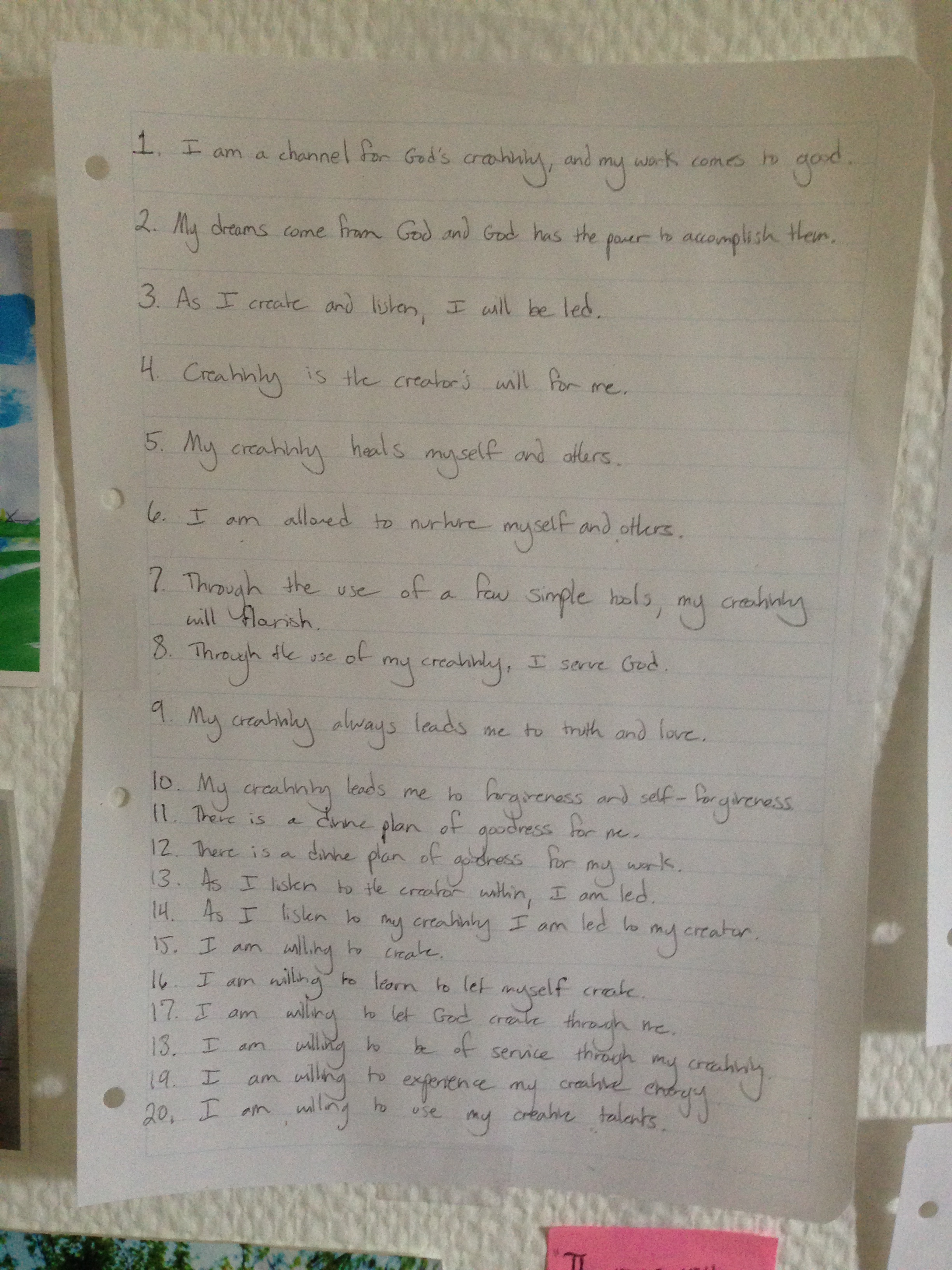
So what are some things in this book? One central practice of The Artist’s Way is the “morning pages.” This is three pages of handwritten, uncensored brain “blah” –whatever— first thing in the morning. Write them. Turn the page. And most importantly: don’t read them. At certain points, I was waking up at 5:30 in the morning to get my morning pages done. I said “no” to a lot of late night activities. While I don’t wake up at 5:30 every morning to get them done anymore, they’ve become a vital part of my creative practice, and on average I get them done 6/7 days of the week.
Other practices prescribed in The Artist’s Way include going on weekly “artist dates” and flipping unconscious assumptions about artists and the artist life. These often come up during the morning pages. For example, one unconscious belief blocking someone from being an artist/creator might be something like: “If I let myself pursue being an artist, my emotional life will be tumultuous and result in tumultuous relationships (because artists are crazy!).” This can become: “It’s possible to be an artist and also have satisfying and stable relationships. Artists can be stable.”
Once I started confronting these (untrue) beliefs, things really started shifting and moving. Learning to talk back to the “negative critic” in our heads and confront these unconscious assumptions is a really important (and difficult) part of unblocking as an artist. There are so many false beliefs about artists that permeate our culture and that we, in turn, have absorbed: “A remarkable number of toxic myths about artist flourish. In addition to our purportedly being broke, irresponsible, drug-riddled and crazy, artists are also deemed selfish, out of touch with reality, megalomaniacs, tyrants, depressives and, above all, people who ‘want to be left alone'” (219). The Artist’s Way will soon have you asking yourself, “Why do I believe these things? Why do I believe they must be true? Are they true?” To your surprise, you may find yourself shifting from thinking things like: “Artists are: drunk, crazy, broke, irresponsible, loners, promiscuous, doomed, unhappy…”
To: “Artists can be: sober, sane, solvent, responsible, user-friendly, faithful, saved, happy…” (32).
Even then, if we accept that “okay, perhaps it’s possible to be responsible or maybe make a living as an artist…” there are still many other excuses we come up with to stay creatively blocked or avoid doing the work. One of my favorites: “‘But don’t you know how old I will be by the time I learn to really play the piano / act / paint / write a decent play?'” To which Cameron responds: “‘Yes…the same age you will be if you don’t.’ So let’s start” (30).
Full circle
 For some reason, it seems fitting that the conclusion of the book coincided around the time of a full moon — a literal full circle, a time for reflection, and the start of a new beginning. Looking back over the past couple of months, it’s really amazing all the subtle shifts and changes that have been taking place. I’ve gone from thinking that my writing / voice / creativity didn’t matter at all, to accepting that my creativity is a gift I need to use. I’ve even been dancing in public.
Two particularly transformative moments stand out in my mind that I’ll share in conclusion. One was recognizing that I didn’t have to view writing as “just something fun I do in my free time but stuff that can’t really count as ‘work.'” Hah! It was incredibly validating to turn that simple idea around and say, “In my book, writing does too count as ‘real work!'” and give myself some credit for the emotional labor and time it requires of me, rather than making myself feel guilty for “wasting time,” simply I wasn’t making money off of that work.
At another point I became incredibly angry at Cameron’s affirmation: “Creativity is a blessing I accept.” I read that affirmation on a day where it felt particularly alienating to have this urge to create, this need to write, and excruciating to put other areas of my life on hold to pursue this creative path, all while the “inner critic” shouted, “Why are you doing this? Do you really think you can make a living pursuing this? It’s a waste of time! Blah blah blah.” So instead, I muttered most of the day: “Creativity is a curse that makes my life difficult and alienates me from others!” (So melodramatic, hah!) This one was particularly tricky to work through. However, I have to admit, the more I (even begrudgingly) plodded along through the course, the easier it began to feel, and I found myself thinking, “HM, wow, creativity is a blessing I accept.” And suddenly, as I asked the universe for creative partnerships, I found myself finding and being surrounded by creative partnerships and supportive friends.
I’ll leave you with a couple final thoughts from Cameron. If our ideas and creativity come from god, Cameron believes it’s our work to realize them and bring them into existence. In fact, to not do so is contrary to our true nature. She writes in chapter twelve: “We are not accustomed to thinking that God’s will for us and our own inner dreams can coincide. Instead, we have bought the message of our culture: this world is a vale of tears and we are meant to be dutiful and then die. The truth is that we are meant to be bountiful and live. The universe will always support affirmative action. Our truest dream for ourselves is always God’s will for us” (194). With this framework, we can stop thinking of our creative ideas as “selfish” or a “waste of time” or “something just to do in our free time,” but what God himself / the universe / Creativity calls us to do. These ideas may seem shocking or hard to accept; you may have to sit with them awhile (maybe a couple of months!).
These ideas have been incredibly transformative for me. Doing this book has resulted in me forming a creative group, sharing things I’ve been writing, and even pursuing a dance / video project. I’m starting to realize dreams I’ve had for several years and it feels good and yes, a bit scary! I don’t know exactly where these creative projects will take me, but part of the creative process is trusting the “darkness”–the mystery. One of Cameron’s favorite phrases that she repeats through the book is: “Leap and the net will appear.” In the doing, we find our answer. Going through The Artist’s Way has helped jumpstart my creative process and personal practice(s). Now, I’m taking the next steps and discovering that the path is appearing in front of me as I go; I’m leaping and the net is appearing.

Thanks for reading.
xo,
Sarah
 Sarah the Adventurer
5 replies on “Leap and the Net Will Appear”
Dear Sarah,
Thanks for writing and letting us know what has been going on in your life this past year. We are glad to keep in touch. Hopefully, we can see you some time when you are home this summer.
Love,
Grandma Reedy
I hope so too! ❤
be a creator and not a consumer…
You should also read: Pope St. John Paul II’s: Letter to Artists: …in writing this letter has called attention to the need for the artist’s work to help “affirm that true beauty which, as a glimmer of the Spirit of God, will transfigure matter, opening the human soul to the sense of the eternal”. The vocation of being an artist is well established in the Catholic church. 🙂
I’ll have to check it out!